
What High-Performing Service Businesses Do Differently
Excerpt
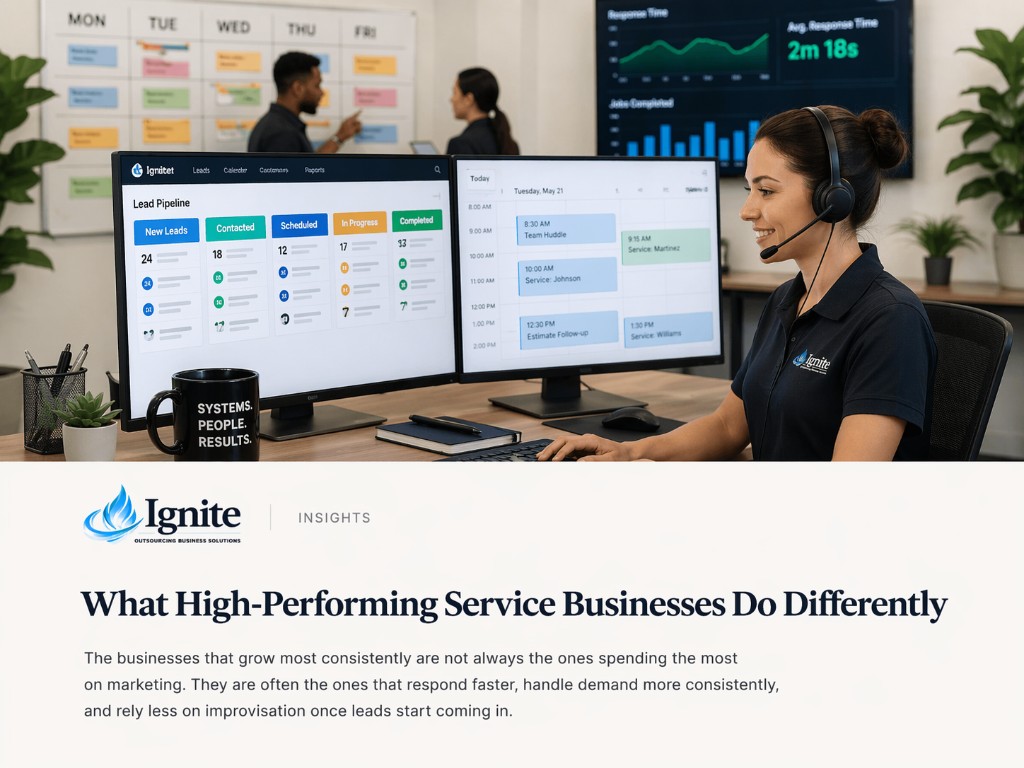
The businesses that grow most consistently are not always the ones spending the most on marketing. They are often the ones that respond faster, handle demand more consistently, and rely less on improvisation once leads start coming in.
Most service businesses think growth is mainly a marketing problem.
It is not.
Marketing can bring attention, but it cannot fix slow response times, missed calls, weak follow-up, or unclear workflows. Harvard Business Review found that companies responding to leads within an hour were nearly 7x more likely to qualify them, yet the average response time in its study was 42 hours, and 23% of companies never responded at all.
That gap is where better-run businesses pull ahead.
1. They respond faster
High-performing service businesses do not treat speed like a minor detail. They know delay reduces value.
Lead-response research cited by InsideSales/XANT found that the odds of making contact are dramatically higher when outreach happens in the first few minutes, and that over 30% of leads are never contacted at all. In practice, that means many businesses are not losing to competitors with better ads. They are losing to competitors who simply respond first.
2. They miss fewer calls
For call-driven businesses, missed calls are not just an inconvenience. They are lost opportunities.
Invoca reports that 27% of calls to home services businesses go unanswered, and that less than 3% of callers sent to voicemail leave a message. If your business depends on inbound calls, missed call volume is not a support issue. It is a revenue issue.
3. They rely less on memory
Average businesses often run on effort. Stronger businesses run on process.
When follow-up depends on whoever is free, whichever shift is active, or whether someone remembers to call back, results become inconsistent. Better businesses reduce that randomness. They create clearer ownership, simpler lead tracking, and more reliable handoffs so demand does not disappear between departments. This is the operational difference between staying busy and growing with control. That inference is consistent with the lead-response and customer-service data above, even though those studies measure outcomes rather than internal workflow design directly.
4. They treat customer experience like a growth lever
The best-run service businesses understand that response quality affects revenue, not just reputation.
HubSpot’s 2024 State of Service report says more than half of CRM leaders report that customers expect problem resolution in three hours or less. Salesforce reports that 88% of customers say good customer service makes them more likely to purchase again. Faster, clearer handling is not just operational discipline. It directly supports retention and conversion.
5. They build systems before adding pressure
Many businesses try to grow by adding more campaigns, more channels, and more activity. Better businesses first make sure the back end can handle more demand.
That means cleaner communication, stronger follow-up, better visibility into what came in, and fewer opportunities slipping through the cracks. More marketing on top of weak operations usually creates more pressure. Better systems make growth easier to sustain. The research does not claim “systems outperform marketing” as a universal law, but it strongly supports the narrower point that response speed, consistency, and handling quality materially affect outcomes.
Final thought
The businesses that perform best are not always doing more.
They are often doing the important things more consistently:
- responding faster
- missing less
- following up better
- handling demand with more structure
That is what high-performing service businesses do differently.