
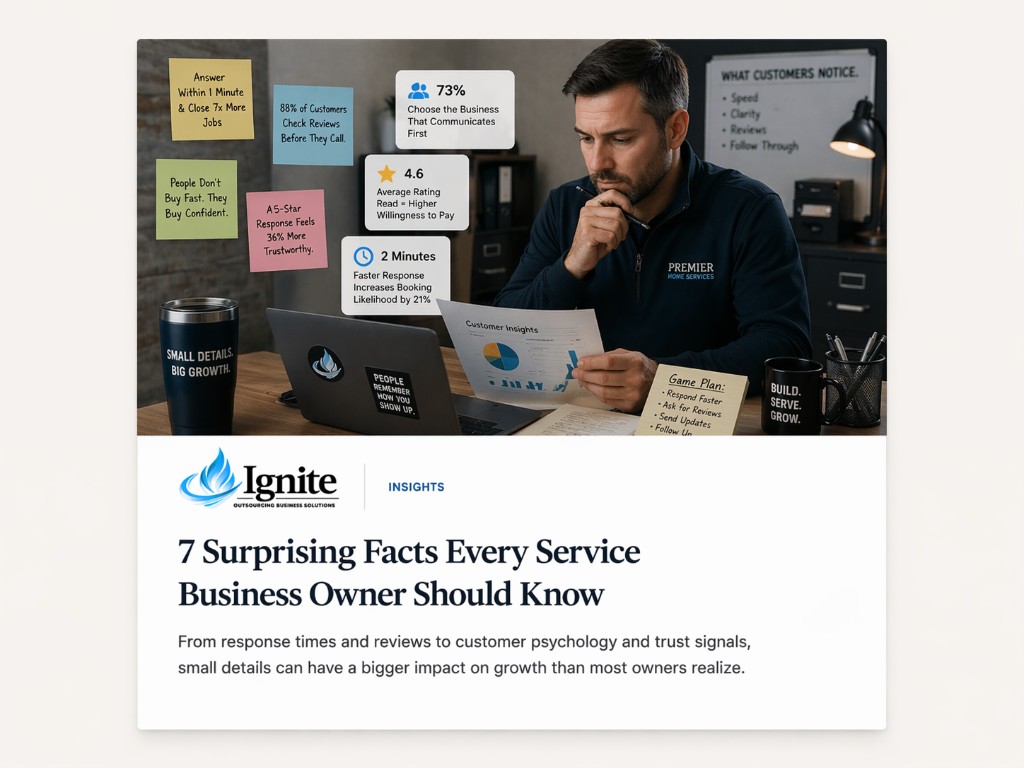
7 Surprising Facts Service Business Owners Should Know About Leads, Calls, and Customer Response
Excerpt
Most service businesses think growth comes down to getting more attention. But a lot of revenue is won or lost in the moments right after a customer reaches out. Here are 7 useful facts, backed by research, that explain why faster response, clearer communication, and better systems matter more than many owners realize.
When business owners think about growth, they usually think about marketing first.
More ads. More content. More traffic. More leads.
But some of the biggest growth advantages are not creative. They are behavioral. They come from understanding how customers think, how quickly interest fades, and how easily trust is lost when response feels slow or disorganized. That is where a lot of better-run service businesses quietly separate themselves from the rest.
1. Speed feels like competence
Customers do not only judge your business by the final service. They also judge it by how quickly and clearly you respond. In practical terms, fast response creates a psychological shortcut: people read it as a sign that your business is organized, attentive, and reliable. That helps explain why Harvard Business Review reported that firms responding to leads within an hour were almost 7 times more likely to qualify them than firms that waited even an hour longer.
What strong service businesses do: They treat first response like part of the service itself, not an admin task.
2. Customers are less patient than most teams think
HubSpot’s 2024 State of Service report says more than half of CRM leaders report that customers expect problem resolution in three hours or less. HubSpot also reports that 82% of customers want issues solved immediately. That means the bar is no longer “reply eventually.” The bar is speed, clarity, and momentum.
What strong service businesses do: They reduce waiting wherever possible, because delay creates doubt.
3. A missed call is usually a lost chance, not a delayed one
Many owners still treat missed calls like something that can be cleaned up later. In reality, missed calls often behave more like lost opportunities than postponed ones. Invoca reports that 27% of calls to home services businesses go unanswered, and fewer than 3% of callers sent to voicemail leave a message. In plain terms, voicemail is not much of a safety net.
What strong service businesses do: They build processes to catch more calls live and follow up faster when they cannot.
4. People trust businesses that reduce uncertainty
One of the most useful psychology principles for service businesses is simple: people prefer certainty. If a customer does not know when they will hear back, who is handling the request, or what happens next, trust drops. Research on complaint handling has shown that response time affects satisfaction and return intent, which fits what service businesses see every day: the faster and clearer the reply, the more secure the customer feels.
What strong service businesses do: They make the next step obvious. Customers know someone received the inquiry, what happens next, and roughly when.
5. A lot of businesses never follow up at all
This is one of the ugliest facts in lead handling. HBR’s lead-response research found that 23% of companies in the audit never responded at all. InsideSales/XANT has also published that over 30% of leads are never contacted. That is not a branding issue. That is process failure.
What strong service businesses do: They rely less on memory and more on ownership. Someone knows who follows up, when, and how.
6. Good service does not just protect retention. It supports future revenue
Salesforce reports that 88% of customers say good customer service makes them more likely to purchase again. That matters because response quality is not only about solving today’s issue. It affects tomorrow’s repeat business, referrals, and overall brand trust.
What strong service businesses do: They treat communication quality as a growth lever, not just a support function.
7. The best-run businesses remove reliance on improvisation
Average service businesses often depend on effort. Better ones depend on systems. That is not because systems are glamorous. It is because consistency beats improvisation. When leads are tracked, handoffs are clear, and follow-up is not left to chance, performance becomes easier to repeat. This is an inference from the response-time and customer-service data, but it is a practical one: better structure improves speed, clarity, and reliability.
What strong service businesses do: They build cleaner workflows before adding more pressure through more marketing.
Final thought
A lot of businesses assume growth comes from doing more.
Often, it comes from doing a few critical things better:
- replying faster
- missing less
- following up consistently
- making the customer feel clear, not uncertain
That is usually what higher-performing service businesses do differently. And over time, those small advantages compound.
CTA
Ignite helps service businesses improve lead handling, customer communication, dispatch support, automation, and front-end systems so growth is supported by stronger operations, not just more activity.